Multiplex publishes rigorously reviewed original research, methods papers, and short perspectives that advance understanding across the natural, physical, computational, and social sciences. Multiplex exists for work that does not sit neatly inside a single discipline, evaluated by scientists who can judge it on its merits rather than its fit to one field.
Journal metrics
Calls for papers
Latest articles
Loading…
Journal updates
Overview, scope & policies
Multiplex welcomes original research, methods papers, and short perspectives from any scientific discipline, with a particular interest in work that crosses disciplinary boundaries. The journal was founded to give cross-disciplinary and boundary-spanning research a peer-reviewed home, evaluated by scientists who can assess it on its merits rather than its fit to a single field.
Aims & scope
Manuscripts outside the areas below are desk-declined without review.
Editorial board
Placeholder roster — replace with your journal’s actual editorial board
Policies & indexing
Double-blind peer review · CC BY 4.0 open access · no submission or processing charge during the launch volume · every manuscript is similarity-screened before it goes to reviewers.
Indexing & abstracting status — editors update this list from Journal Settings as each application progresses
Browse published research
—
Loading…
Submission guidelines
Before submitting, check your manuscript against the points below. Manuscripts are handled through this page — there is no separate external submission system.
Manuscript preparation & formatting
Multiplex accepts two manuscript types: research articles (original methods, analysis, or field/lab studies, 4,000–7,000 words excluding references) and perspectives (short, focused commentary or synthesis pieces, 2,000–4,000 words). Submit as a single Word (.docx) or PDF file prepared on the manuscript template below, using Times New Roman throughout (title 14pt; body text, headings and references 12pt), single line spacing, with continuous line numbers for the review copy.
Structure the manuscript in this order:
- Title — concise, clear and informative, 20 words or fewer
- Author names & affiliations — every author's name and affiliation, ORCID iD, and the corresponding author's email clearly marked
- Abstract (up to 250 words, one paragraph, covering background of the problem, research objectives, methods, results, and conclusion) and 3–5 keywords (semicolon-separated)
- Introduction — the problem being studied, why it matters, and how the paper approaches it, with prior work cited in text
- Method — a single operational paragraph covering research type, approach, data sources, and analysis technique
- Results and discussion — combined rather than separated into two sections, organized around the problem formulation
- Conclusion — one or two paragraphs answering the research problem
- Acknowledgements (optional)
- Author contributions, conflict-of-interest statement and data availability statement (see Author declarations below)
- References
Report quantities in SI units and define any field-specific notation, method, or instrument on first use — reviewers and readers may come from outside your discipline. Number figures and tables sequentially, caption each (e.g. “Figure 1. …”, “Table 1. …”, with a source line), and refer to every one by number in the text.
Reference style — cite sources in text using APA (6th edition) author–date format, e.g. (Author, Year) or (Author et al., Year), and list at least 20 references at the end of the manuscript in alphabetical order. Reference only books, journal articles, and conference proceedings:
Smith, J. K. (2024). Methods in Cross-Disciplinary Research. Academic Press.
Manuscript template
Prepare your submission directly on the journal’s manuscript template — it already has the required section headings, fonts, and sizes set up, plus annotated instructions for each part (title, abstract, introduction, method, results and discussion, conclusion, references) that you replace with your own content.
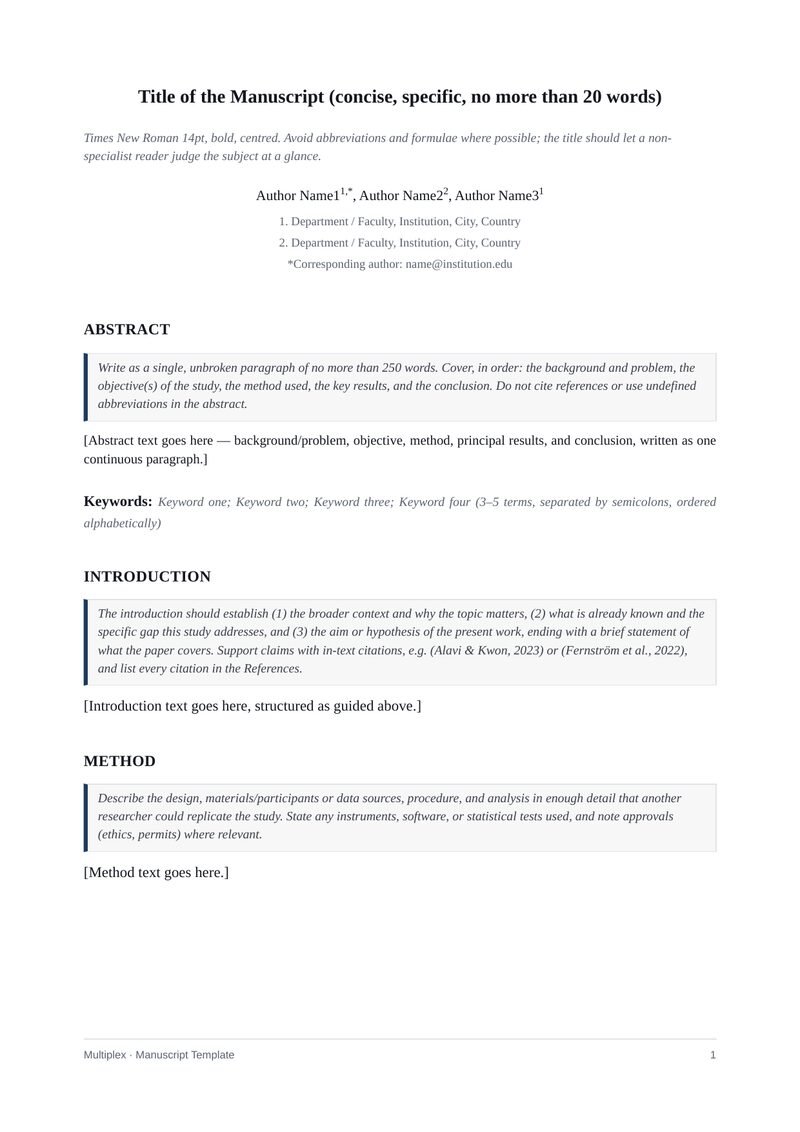
Preview of page 1, shown at left. Click it to open the full PDF, or download your own copy to fill in below.
Provided as a PDF here. Contact the editorial office (see “Submit your manuscript” below) if you need the original editable Word (.docx) version to build your manuscript on.
Author declarations
- Authorship. Every listed author must have made a substantial contribution to the work's conception, design, analysis or interpretation, drafted or critically revised the manuscript, and approved the final submitted version. The corresponding author is accountable for the accuracy of the author list at submission and for keeping co-authors informed.
- Conflict of interest. Disclose any financial, professional or personal relationship that could reasonably be seen to influence the work — for example, funding from an organization with a stake in the result, or a consulting relationship relevant to the topic. State “The authors declare no conflict of interest” if none applies.
- Data availability. Briefly state where supporting data (datasets, code, survey instruments, field records) can be accessed, or explain why it cannot be shared (for example, participant confidentiality or third-party ownership).
- Permission to publish third-party or sensitive data. Where a manuscript reports data or images from a named organization, site, or identifiable participant, confirm in the cover note that permission to publish has been obtained.
- ORCID. A free ORCID iD (orcid.org) for the corresponding author is recommended — it keeps your work correctly attributed across databases and indexing services.
These policies sit alongside Multiplex's full , which also covers plagiarism screening, corrections and retractions, and how misconduct concerns are handled.
Peer review process
Every submission is first checked by the editorial team for scope, completeness, and similarity screening (see the publication ethics statement), then sent for double-blind review by two members of the editorial board or invited reviewers. A first decision is targeted within about three weeks; you can follow every stage under “Track your research.”
Full details on reviewer selection, decision categories, confidentiality, and appeals are in Multiplex's .
Submit your manuscript
Reading Multiplex
Every article Multiplex publishes is immediately and permanently free to read — there is no subscription, paywall, or account needed to browse the journal. Each article publishes under a CC BY 4.0 licence, so you are free to share, adapt, and reuse it for any purpose, including commercially, as long as you credit the original authors.
Finding articles
Browse the or the full , or search by title, author, or keyword from the search icon in the top bar. Articles are also grouped by subject under “.”
Citing an article
Open any article to see a ready-made citation with its DOI in the “Cite this article” box. Once an article has a registered DOI, that link will always resolve to the current version of record.
Staying up to date
Sign up above for an email whenever a new issue or call for papers goes live, or check “” any time — no account is required either way.
Information for librarians
We encourage research librarians to list Multiplex among their library’s electronic journal holdings. The journal is fully open access under a CC BY 4.0 licence, so there is no subscription, licensing fee, or institutional agreement required — only a cataloguing entry pointing readers here.
Cataloguing details
Indexing & abstracting status
Current status of the journal’s applications to major indexing and abstracting services:
Questions
For anything not covered here — MARC records, consortium agreements, or preservation arrangements — reach the editorial team via the corresponding-author contact on any published article, or through the journal’s page.
Calls for papers & news
Calls for papers
Recent updates
Track your research
Loading…
Editorial dashboard
Loading…
The database behind Articles & Volumes — add back-issue content directly, or fix a typo without re-running the submission workflow. New research normally still arrives via the submission pipeline’s “Publish to issue.”
Loading…
Journal settings
Changes here save to the live database and update the site for every visitor immediately.
Loading…